
A hair transplant for Asian men uses the same methods as for anyone else, but the plan often has to allow for straighter, thicker, darker hairs and, in some groups, fewer of them per square centimetre. Those are averages, and your own hair, scalp and pattern of loss matter more than your background.
“Asian” covers people from Japan to Pakistan and from China to Indonesia, with every kind of hair between straight and curly. Most of the research quoted here studied Chinese, Korean or Thai people. If you are South Asian, of mixed heritage, or your hair simply does not fit the description, some of this may not apply to you.
Straight, thick hair: help and challenge
The International Society of Hair Restoration Surgery (ISHRS) says East Asian hairs tend to be thicker but fewer per area than those of white people, and that the scalp can look denser than it is as a result. A thick hair covers more than a fine one.
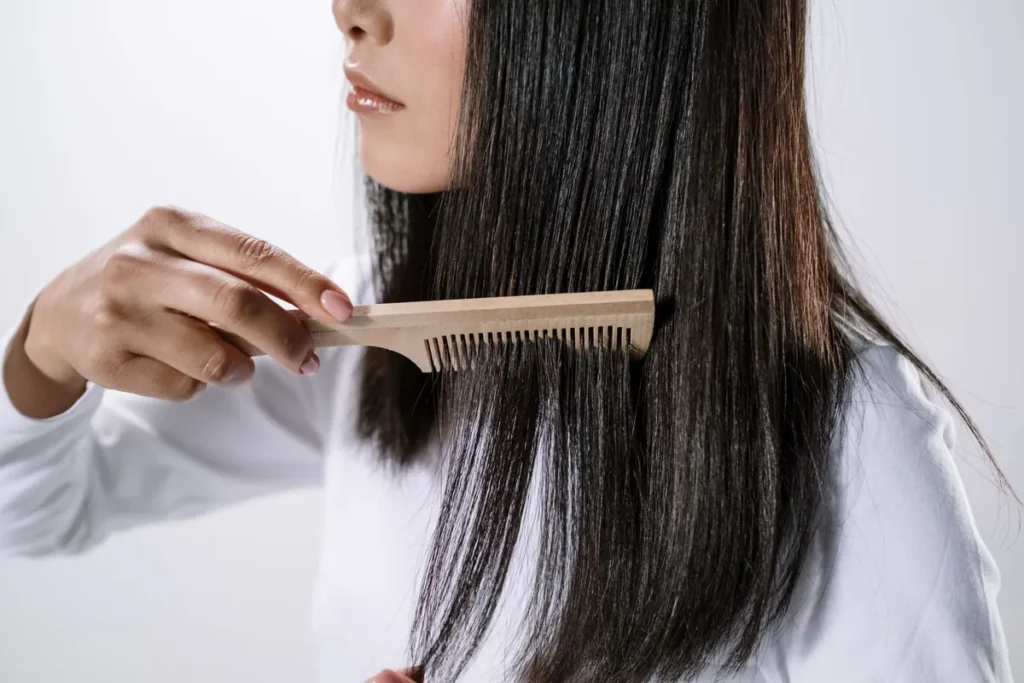
The same thickness is less helpful at the front edge. A natural hairline is soft, and a coarse hair standing alone can look like a bristle. In a Korean surgical series, only single-hair grafts were placed along the hairline, and grafts were sorted by thickness to match the hair already there. That series was in women, so it is a guide and not a rule for men. See also hairline transplants.
Straight hair also shows its direction. Curl can hide small differences in angle, while a straight hair that points the wrong way is easier to see, especially when cut short. The Korean team advised matching the existing hair’s angle, direction and thickness.
Density: how much donor hair is there?
Grafts come from the back and sides of the head, and that supply is limited. Studies give a guide to the range, not to your number.
| Study | What it found |
|---|---|
| Han Chinese volunteers, 2017 | About 159 hairs per square cm at the back of the head, in about 83 natural groups (follicular units) |
| Han Chinese people with pattern hair loss, same study | About 148 hairs per square cm at the back, lower than in the volunteers |
| 47 Thai men planning a transplant, 2023 | Scalp samples from the back showed lower average density than published figures for other Asian groups without hair loss |
The methods differ, so the rows cannot be compared directly. One lesson is still useful. The donor area may itself be affected by hair loss, so it should be examined closely and not guessed from a photograph.
Where donor density is lower, the ISHRS notes that a larger donor area is needed for the same number of hairs. Taking too many from a small patch can leave it looking thin, which is one reason for a careful limit in FUE.

Contrast between hair and skin
Black hair on lighter skin makes a strong contrast, so gaps can look more obvious. Korean authors describe a substantial contrast between skin and hair colour in East Asian patients, and another Korean group suggests that lower density with more contrast makes small changes easier to notice.
Pinpoint FUE scars can be more noticeable with dark hair or darker skin. Tell the doctor how short you like to wear the sides and back, because a very close fade leaves little to hide behind.
Hairline shape for Asian men
There is no single Asian hairline. Still, the ISHRS describes East Asian heads as rounder than the long, narrow shape common in white people, and says placement must be adapted to head shape. It adds that culture can influence what people want.
A few things to settle while the line is being drawn:
- Height. A low line uses more grafts and may look out of place as you age.
- Corners. Filling both temples to a straight line can look drawn on. Some recession is common in adult men.
- Face shape. Look at the design from the front, both sides and three-quarter view, with your hair pushed back.
Pattern of loss comes first
Reported rates vary widely. One review quotes about 14% of men in a Korean study and 39% in a Thai one. Patterns vary too. Korean studies report thinning of the “female pattern” type in 11% to 37% of men with pattern hair loss, which the authors say is higher than in white men.
That matters because diffuse thinning can reach the donor area, and because existing hairs can shed for a while after surgery, known as shock loss. For some men the first step is a diagnosis and non-surgical care, and surgery may not be advised.
Scarring and keloid history
A keloid is a raised scar that grows beyond the original wound. The NHS lists people of South Asian, Chinese, African Caribbean or Black African background among those more likely to get them. The British Association of Dermatologists also names Asian descent, while noting that only a minority of people develop them.
After FUE they appear to be very unusual. A 2026 review calls abnormal donor scarring rare and keloids exceedingly uncommon, mostly case reports. The risk is higher with a personal or family history. For people at high risk the review describes a small test session, and the ISHRS says a keloid history should be evaluated before surgery.
So before anything is booked, mention any thick or itchy scar on your chest, shoulders, ears or jaw, scars from acne, piercings or earlier surgery, and any close relative with keloids. The doctor may advise a test, a referral to a dermatologist, or no surgery.
What changes in planning
Doctors have written guidelines for East Asian patients, drawn from surgeons’ experience and a review of published papers. In practice, ask your doctor about:
- The measured donor density and how many grafts will be left in reserve.
- The share of single-hair grafts, and where they will go.
- The punch size and spacing, given your hair and how short you wear it.
- Your scar history, and whether a test area is wise.
- What the plan will look like if the hair behind it keeps thinning.

Common questions
Is an Asian hairline transplant harder to make look natural?
It can need more care at the front edge, because straight, dark, coarse hairs show angle and spacing clearly. Fine single-hair grafts, an uneven edge and correct direction all help, but no doctor can promise an exact look.
Do Asian men need more grafts?
Not as a rule. Thick hairs can cover well, while lower density and strong contrast can pull the other way. Our graft calculator is only a starting point.
Will FUE scars show if I shave my head?
Small dots may be visible on a shaved or very closely cut scalp, and their colour and size vary from person to person. If you want to keep a shaved look, say so early, as it may be a reason to think again.
Does this apply to Asian women?
Some of it does, including hair thickness, contrast and scar history. The causes and patterns of hair loss are often different, so begin with our page on hair transplants for women and a diagnosis.
Can I get an opinion from photos?
Clear photos in good light help a doctor say whether an examination is worthwhile, but they do not replace measuring density and thickness in person. You can arrange a consultation and mention any keloids or family history when you write.
Sources
- Hair restoration in East Asians, International Society of Hair Restoration Surgery
- The distribution of hair in Han Chinese, Plastic and Aesthetic Research 2017
- Hair follicle counts of occipital scalp biopsies from male hair transplant patients in Thailand, Siriraj Medical Journal 2023
- Side-hairline correction in Korean female patients, PRS Global Open 2015, via PMC
- Five-year study of Korean men with androgenetic alopecia, via PMC
- Review of androgenetic alopecia in Asia, KoreaMed Synapse
- Guidelines on hair restoration for East Asian patients, Dermatologic Surgery 2016, abstract
- Complications in follicular unit excision hair transplantation, Frontiers in Medicine 2026, via PMC
- Keloid scars, NHS
- Keloids, British Association of Dermatologists