
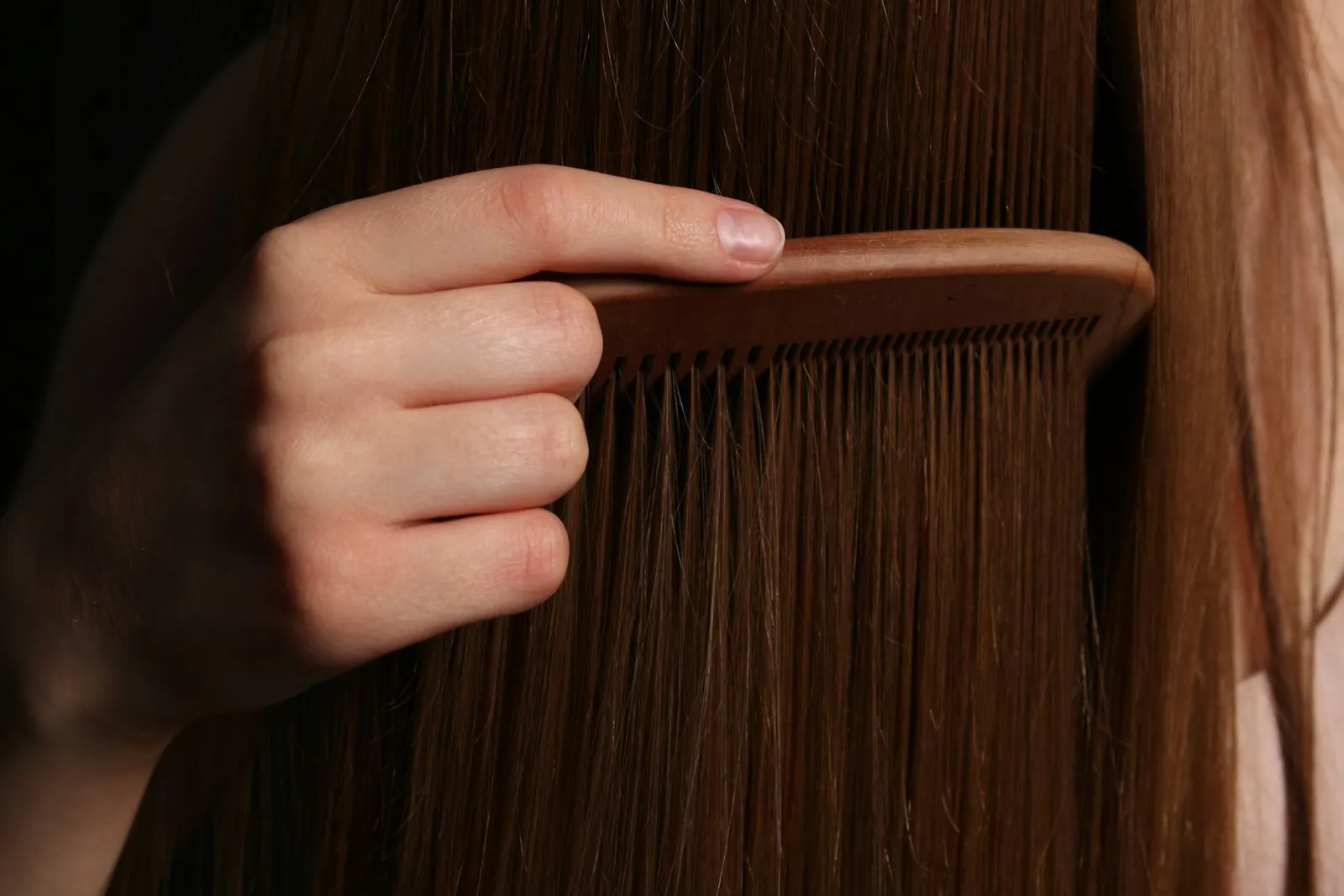
Yes, many women can get hair transplants without shaving the head. Usually some donor hair still has to be trimmed, often in a strip that the longer hair above it covers, and fully unshaven methods exist but are slower and do not suit every case.
So the useful question for a consultation is not whether you will be shaved. It is which hair will be cut, how short, and whether you can cover it with the way you wear your hair.
Female hair transplant options without shaving the whole head
| Approach | What is cut | Trade-off |
|---|---|---|
| Full donor trim | The back and sides, very short | Simplest access and even spread of extractions, but hard to hide |
| Trimmed strip or zones | One or more bands under longer hair | Easy to cover, but limits how many grafts can be taken |
| Selective trimming | Only the small groups of hair to be taken | Little to see, but slow |
| Long hair FUE | Grafts are taken with hair left long | No donor shave, but longer surgery and specialist skills |
| Strip surgery (FUT) | A strip of scalp, with nearby hair left long | No shaving of the donor area, but a linear scar. We do not offer this method |
Most FUE is done with donor hair cut to between 0.5 and 1.5 mm. That is why any answer that begins “no trimming at all” deserves a follow-up question.
A trimmed strip under long hair
This is the common middle way. Hair is pinned up, a band at the back of the head is clipped short, grafts are taken from it, and the longer hair is let down again over the top. Our page on hair transplant for women shows where it fits in the wider plan.
It has limits. The ISHRS guidelines describe small strips or zones for smaller FUE procedures, and advise three things:
- take grafts at low density, to avoid thin-looking patches
- use a different place if you have another session
- avoid this approach for anyone who might wear their hair shorter than about 10 to 12 mm, because the zones may show
Think about your real habits. A strip that vanishes under loose hair may show with a high ponytail, an undercut, very fine hair or wet hair at the pool. Bring photos of your usual styles, or wear your hair that way to the appointment.
The limits of no-shave methods
In no-shave FUE, the chosen hairs may be snipped one group at a time, or cut by the punch itself. In long hair FUE, the punch has a slot that keeps the hair uncut. You see a preview at length straight away, although transplanted hair normally sheds before it grows in.
The same guidelines call these highly advanced procedures, not advised for beginners. Long hair can tangle around the punch. A published series of 134 people, 112 of them women, lists longer surgery, more staff and a longer learning curve as drawbacks. About 9.2% of follicles were cut through on average during removal. This was one team’s experience, and one author has a financial interest in a company that makes hair transplant devices, so other teams may see different figures.
Availability differs between clinics. Please do not assume that every method described here is offered everywhere, including here. Ask at your consultation which approaches are possible for you, and who would carry them out.
Does it limit the size of the session?
Often, yes. In the series above, the most grafts placed in one day with long hair FUE was about 2,500, and female hairline correction averaged 1,214. A single trimmed band may give fewer, because the grafts should be spread out.

More grafts are not always the goal. Women can have diffuse thinning even in the usual donor areas, and taking too many can leave the back visibly thin. If your plan needs more than a hidden strip can safely give, the choices are a wider trim, two smaller sessions, or a smaller aim.
When a trim is unavoidable
Expect to be asked for more cutting when:
- the number of grafts is large for the donor area
- the donor hair is thin, so grafts must be spread over a wider zone
- there are scars from earlier surgery to work around
- dense hair in the treated area blocks the surgeon’s view or angle
- the session would otherwise become too long
The treated area is a separate question. For a hairline, the hair behind it can often be pinned back. Placing grafts between existing hairs in a thinning parting is slower, and the doctor may want some of it shortened. Ask about both areas, and get the answer in writing.
Sometimes the better advice is no surgery for now. Every woman with hair loss should be checked for an underlying cause, and heavy shedding or active scarring disease needs a doctor’s attention first. If tight styles caused the loss, it can become permanent the longer it goes on, and the same styles would strain new grafts.
Washing and styling long hair afterwards
Long hair hides the work, but it also catches. A comb, hair tie, earring or zip can pull on a scab. In a small study of 42 people, grafts came out easily in the first two days and no longer did so by about day six. Crusts made the risk last longer, which is one reason gentle cleaning matters.

Advice on the first wash varies. The NHS says gentle hand washing can begin on day six. A recent review reports that delaying washing beyond three days was linked to more marked lasting redness. Use your own clinic’s timing, and ask to be shown how. In general, with the clinic’s agreement:
- detangle the lengths before surgery, and keep them loose afterwards
- pour water from a cup in place of a strong shower jet
- keep the lather on the lengths away from the grafts, and do not rub
- pat dry, and ask when a cool hairdryer is allowed
- leave tight ponytails, braids, extensions, bleach and hot tools until you are told they are safe
Ask for someone to help with the first wash if you are travelling alone. The recovery page covers the stages after that and when to call a doctor.
Common questions
Will people be able to tell?
The donor strip is often covered at once. The front is harder: scabs and redness along a hairline can be visible for one to two weeks, and a fringe may not be comfortable against it at first.
How long does the trimmed strip take to blend in?
Hair grows slowly, so the strip stays much shorter than long hair for a good while. What matters is whether the layer above it is thick enough to cover it.
Can shedding happen even if nothing is shaved?
Yes. Existing hair near the grafts can shed for a time, usually beginning two to eight weeks after surgery, and the donor area can shed too. Transplanted hair normally falls before it regrows. Women with thin hair may notice this more, so plan for it.
Is unshaven surgery more expensive?
It may be, because it takes more time and staff. The cost page explains what shapes a quote, and you should compare quotes that describe the same method.
What should I ask before booking?
Ask to be shown on your own head where hair would be cut, how many grafts that allows, what happens if more are needed on the day, and how it would look tied up. You can book a consultation and send photos of your hair down, tied back and parted.
Read next
Sources
- FUE guidelines 2019, International Society of Hair Restoration Surgery
- A guide to hair transplant for women, International Society of Hair Restoration Surgery
- Long hair FUE study, International Journal of Dermatology 2021
- Hair transplant, NHS
- Graft anchoring in hair transplantation, Dermatologic Surgery 2006
- Complications in follicular unit excision hair transplantation, Frontiers in Medicine 2026
- Overview and algorithmic approach to management of male and female pattern hair loss, Indian Journal of Plastic Surgery 2021
- Hairstyles and hair loss, American Academy of Dermatology