

A hair loss doctor in Bangkok should first work out why you are losing hair, then tell you which treatments fit that cause and whether you need one at all. Most of the answer comes from your history and a close look at your scalp, with blood tests or a small skin sample only when something points to them.
That order matters. Pattern loss, shedding after an illness and scarring disease can look alike in a mirror, and they need very different care.
What the doctor will ask
The first questions are about time and pattern: when it began, whether it was sudden or slow, and whether hair is falling from the root, breaking, or simply getting finer.

Others are about you:
- Illness, fever, surgery, childbirth or a hard period in the months before
- Weight change, diet, periods, menopause or contraception
- Every medicine and supplement you take
- Family history
- Itching, burning, pain, scale or spots on the scalp
- Tight styles, extensions, bleaching or relaxing
- What you have already tried, and for how long
Look back further than last week. Shedding can start around three months after its trigger, so the event is easy to miss.
Causes a hair loss doctor checks for
| Possible cause | What might point to it |
|---|---|
| Pattern hair loss | Slow thinning at the hairline, temples, top or parting, often with a family history |
| Telogen effluvium (shedding) | A sudden rise in hair fall all over, some months after a trigger |
| Alopecia areata | Coin-sized, round bald patches |
| Traction | Thinning where hair is pulled tight |
| Scarring alopecia | Pale, smooth skin with no follicle openings, sometimes with itch, pain or burning |
| Infection or scalp disease | Scale, redness, sores or broken hairs |
| Thyroid disease, low iron, hormones | Other symptoms as well as hair loss |
| Medicines | Loss that began after a new treatment |
Two causes can overlap. Someone with mild pattern loss may notice it only when an illness makes them shed. If you suspect a medicine, the American Academy of Dermatology (AAD) says to ask the doctor who prescribed it and not to stop it first.
The scalp examination
The doctor looks at the pattern, the skin and the hairs themselves. This should take in the sides and back as well as the thin area, because that is where donor hair would come from if surgery were ever discussed. Nails may be checked too.
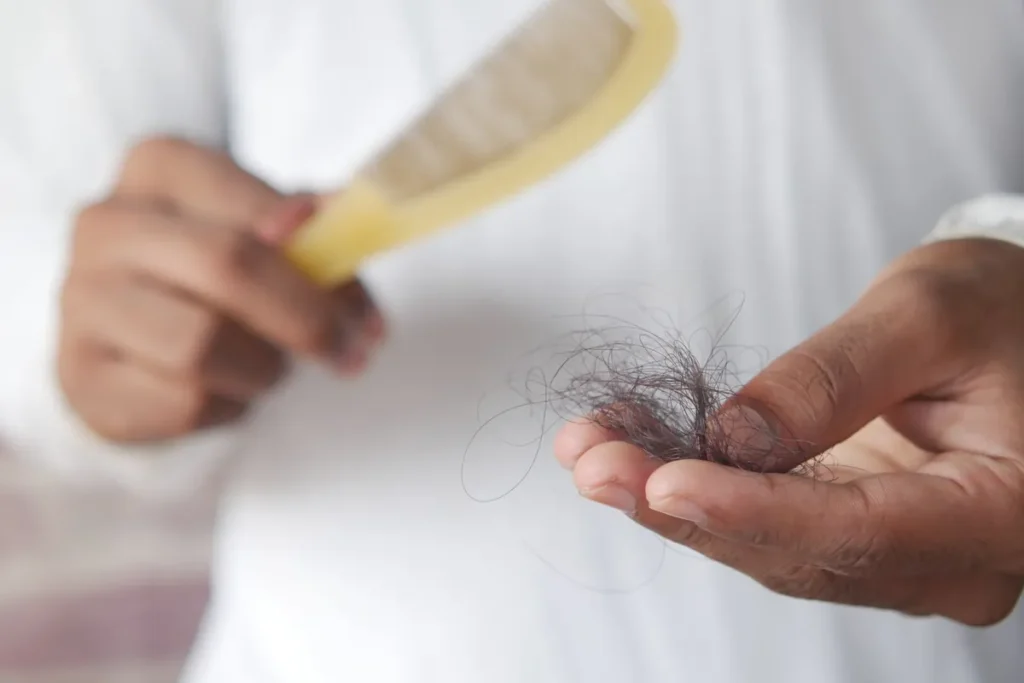
A pull test. A small bundle of hairs is drawn gently between the fingers. The test is called positive if more than 10% come out, but a negative result does not rule out shedding. Washing your hair within the previous 48 hours can make it falsely negative, so ask before your visit whether to leave it unwashed.
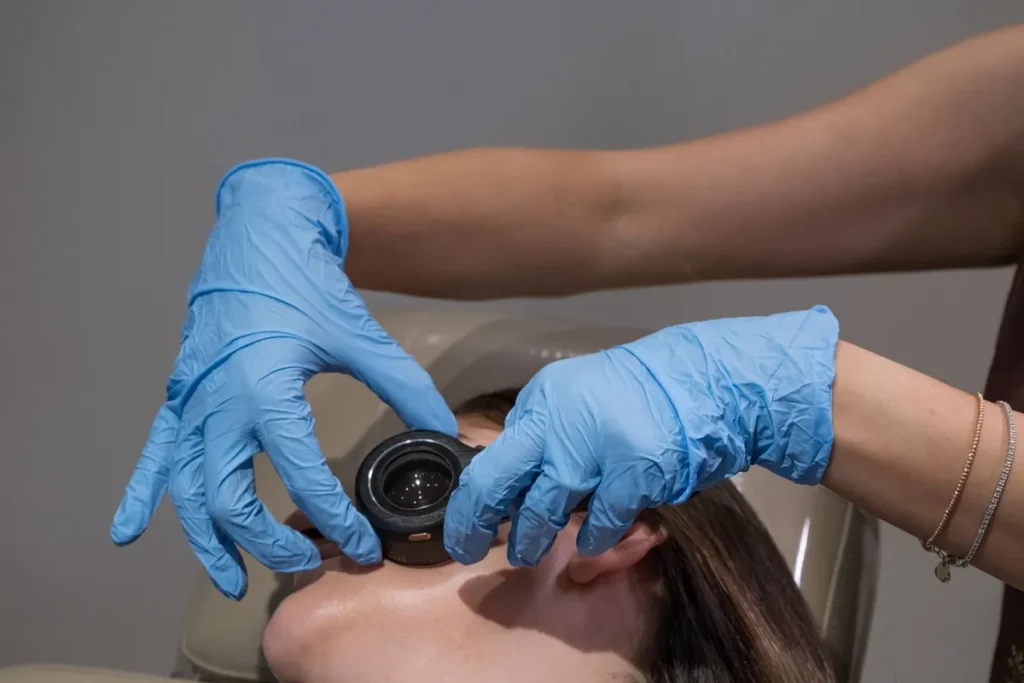
A magnified view. Trichoscopy is a close look at the scalp through a lens or camera. Hairs of clearly different thickness suggest pattern loss, while tapered, broken hairs suggest alopecia areata. Nothing is cut.
A biopsy. If scarring disease is possible or the picture is unclear, a small piece of scalp can be taken under local anaesthetic and looked at under a microscope. It leaves a small scar. Many people do not need one.
Which blood tests might be needed
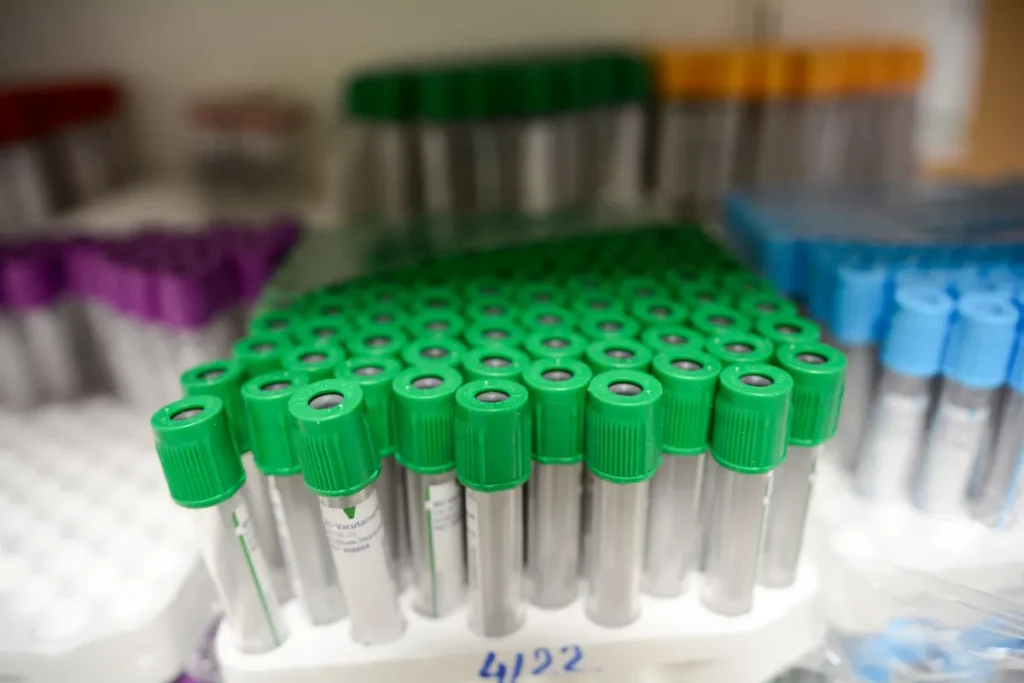
There is no standard hair loss panel. A review for family doctors says there are no routine tests, and that testing is for when the history or examination suggests another condition. Depending on your case, a doctor may discuss:
- Iron and thyroid tests
- A blood count
- Sex hormone levels in some women, for example with irregular periods, acne or extra facial hair
- Tests for infection or autoimmune disease when there are other signs
Doctors differ in how readily they test, so ask what each result would change. Bring recent results with you, since repeating them may be unnecessary.
Two cautions about supplements. The AAD advises taking iron, zinc or biotin only when a blood test shows you lack it. And biotin can make some laboratory results wrong without anyone noticing. Tell the doctor and the laboratory about it before blood is taken.
When surgery is not the answer
A transplant moves hair. It does not treat the reason hair was lost. One review of surgical candidates lists eight groups who are not suitable: people with diffuse thinning that does not follow a pattern, scarring alopecia, unstable loss, too little loss, very young age, unrealistic expectations, certain psychological conditions such as body dysmorphic disorder, and poor general health. The author adds that some may be considered if they accept limited results.
In practice, waiting or treating is usually wiser when:
- Hair is shedding heavily now. After a trigger this typically lasts three to six months, and usually recovers without treatment.
- You have patches that could be alopecia areata, where hair can regrow on its own and further episodes are common.
- There is inflammation. With scarring types, early care aims to protect follicles that are still alive, because lost ones do not return.
- A thyroid, iron or hormone problem has just been found.
- The loss is early, and medicine may hold it.
The page on non-surgical hair loss treatment covers what medicine can and cannot do. You can also see how the clinic approaches planning, including doing nothing.
How to check a doctor in Thailand
Do this for any clinic, including this one, before you pay.
- Ask for the doctor’s full registered name in Thai and English, not a nickname, and the medical licence number.
- Search the name yourself on the website of the Medical Council of Thailand (tmc.or.th). The Council’s secretary-general has said the public can look up a doctor’s name, specialty and photo there.
- Compare the photo and specialty with the person you meet. A medical licence alone does not make someone a dermatologist, so ask about training in hair and scalp disease.
- Check the clinic’s own licence separately. The Department of Health Service Support has an online system, and a missing, expired or revoked entry is a warning. Its hotline is 1426.
If a search fails, ask the clinic for the exact Thai spelling and try again. Do not accept a screenshot in place of your own search.

When to see a doctor sooner
The NHS notes that losing 50 to 100 hairs a day is normal and that hair loss is usually not serious. Do not wait for a trip abroad if you have sudden bald patches, pain or burning of the scalp, pus or sores, or hair loss with fever or unexplained weight loss. See a doctor where you are.
Common questions
Do I need a referral to see a hair loss doctor in Bangkok?
You can ask for a consultation directly. The NHS suggests seeing your own doctor about the cause before going to a commercial hair clinic, and they may already have your history and blood results.
Can a hair loss doctor diagnose me from photos?
Photos help to show which problems are likely and whether a trip makes sense. They cannot replace a close look at the skin, so a plan made from photos should be treated as provisional.
Should I stop my medicines or supplements before the visit?
Do not stop a prescribed medicine without the doctor who prescribed it. Bring the packets or a list, including vitamins and anything bought online, and ask in advance whether a supplement should be paused before blood tests.
What if the doctor finds no cause?
For about one in three people with telogen effluvium no trigger is found. Good photographs and a review after some months may be more useful than more tests.
Sources
- Hair loss: diagnosis and treatment, American Academy of Dermatology
- Hair loss causes, American Academy of Dermatology
- Hair loss: common causes and treatment, American Family Physician, 2017
- Telogen effluvium, British Association of Dermatologists
- Frontal fibrosing alopecia, British Association of Dermatologists
- Alopecia areata, British Association of Dermatologists
- Female pattern hair loss, DermNet
- Trichoscopy of generalised noncicatricial hair loss, DermNet
- Biotin interference with laboratory tests, US Food and Drug Administration
- Candidates for hair transplant, Indian Journal of Plastic Surgery, 2021
- Hair loss, NHS
- Checking doctors, Pattaya Mail, 2025
- Check clinic licences online, Pattaya Mail, 2026